
роторная дробилка pf 1210
PF 1210 Impact Crusher: Specifications, Applications, and Performance in Secondary Crushing
The PF 1210 rotor impact crusher is a mid-sized secondary crushing unit built around a 1,250 mm × 1,050 mm rotor, designed to reduce medium-hard and soft rock—limestone, dolomite, gypsum, coal, and construction debris—from feed sizes up to roughly 350 mm down to a 0–60 mm product at capacities typically cited between 70 and 120 t/h. It sits in the middle of the common PF series (PF 1010, PF 1210, PF 1214, PF 1315), which makes it a frequent choice for quarry operators and aggregate producers who need more throughput than a PF 1010 can deliver but do not have the feed size or budget for a PF 1315. This article covers its working principle, technical parameters, a comparison against neighbouring models, real-world applications, and the maintenance issues that most often determine whether the machine performs to spec.
How the PF 1210 works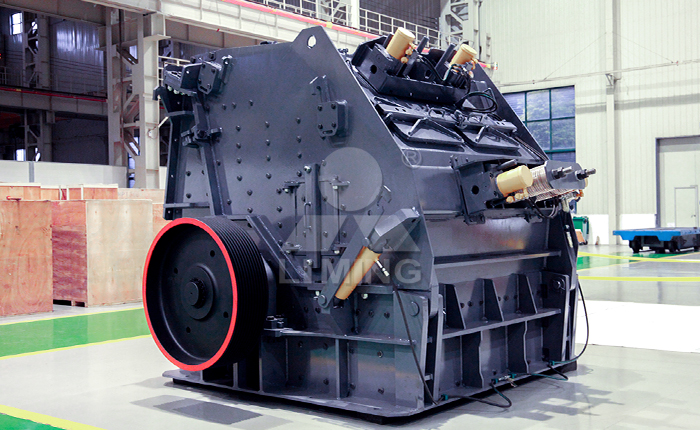
Material enters the crushing chamber and is struck by flat blow bars mounted on the spinning rotor. The impact energy fractures the rock, which is then thrown against the impact plates (curtains) lining the upper chamber and rebounds for further strikes. Because reduction happens largely along natural fracture planes, impact crushers produce a more cubical, less flaky product than jaw or cone crushers, and they achieve a higher reduction ratio in a single pass—typically 10:1 to 20:1 depending on the material.
The rotor is the heart of the machine. On the PF 1210 it turns at roughly 600–800 rpm depending on configuration, and the blow bars are the main wear part. Most modern units use high-chromium (Cr26) or chrome-molybdenum alloy bars, which in limestone service commonly last 400–800 hours per set before rotation or replacement.
Technical parameters (typical)
| Parameter | Value |
|---|---|
| Rotor size | Ø1,250 × 1,050 mm |
| Max. feed size | 350 mm |
| Capacity | 70–120 t/h |
| Motor power | 110–132 kW |
| Overall dimensions (L×W×H) | ~2,580 × 2,400 × 2,810 mm |
| Weight | ~14–15 t |
| Discharge adjustment | Impact plate gap, hydraulic or mechanical |
Note that capacity figures vary by manufacturer and by material. A PF 1210 running limestone at 100 t/h is realistic; the same machine on harder, more abrasive rock such as granite will drop well below that and wear parts will fail much faster.
PF 1210 vs. neighbouring models
| Model | Rotor (mm) | Max. feed (mm) | Capacity (t/h) | Motor (kW) |
|---|---|---|---|---|
| PF 1010 | 1,000 × 1,050 | 350 | 50–80 | 75–90 |
| PF 1210 | 1,250 × 1,050 | 350 | 70–120 | 110–132 |
| PF 1214 | 1,250 × 1,400 | 350 | 100–180 | 132–160 |
| PF 1315 | 1,300 × 1,500 | 350 | 150–220 | 180–220 |
The practical difference between a PF 1010 and a PF 1210 is throughput, not feed size—both accept 350 mm. Moving up to a PF 1214 widens the rotor, which raises capacity without changing the feed opening. This matters when sizing a plant: if your primary jaw produces 150 t/h, a single PF 1210 will bottleneck the circuit, and either a PF 1214 or two smaller units are needed.
Where the PF 1210 is used.jpg)
Limestone aggregate plant, Shandong, China. A 200 t/h crushing line feeds a PE 750×1060 jaw as primary and a PF 1210 as secondary, with a 4YK2160 vibrating screen closing the circuit. Feed to the impactor is 0–300 mm, discharge is screened at 31.5 mm. Reported output is 90–110 t/h of 0–31.5 mm aggregate with a flakiness index under 10%, which meets Chinese GB/T 14685 requirements for concrete aggregate. Blow bar life in this application averages about 600 hours.
Construction and demolition waste recycling, Europe. PF 1210 units are commonly deployed in mobile track-mounted plants for C&D waste, where the goal is liberating rebar and producing a 0–40 mm recycled aggregate. The high reduction ratio lets operators skip a primary stage when the input is already broken concrete rather than demolition slab.
Gypsum and coal processing. Because impact crushers handle soft, low-abrasion material efficiently, the PF 1210 is also used in gypsum board plants and coal preparation, where a 0–30 mm product is required and wear costs are low.
What actually determines performance
Three factors dominate in practice:
- Blow bar metallurgy. High-chromium bars cost more upfront but typically deliver two to three times the life of standard manganese in abrasive service. In limestone, Cr26 is the default choice.
- Impact plate gap setting. This is the only real control over product gradation. Setting it too tight increases wear and power draw without improving shape much; too loose and you get oversize recirculation.
- Feed grading. A PF 1210 fed with a wide spread of sizes, including fines, will underperform. Scalping fines before the crusher usually raises capacity by 10–20%.
FAQ
Q: What is the maximum feed size for a PF 1210?
A: 350 mm is the standard rating. In practice, keeping the largest feed below about 300 mm improves throughput and reduces the risk of blow bar breakage, since oversized slabs can jam between the rotor and the impact plates.
Q: Can a PF 1210 crush granite or basalt?
A: It can, but it is not the right machine for it. Silica content above roughly 10–15% causes rapid blow bar and impact plate wear, and capacity drops sharply. For hard abrasive rock, a cone crusher is the more economical choice over the machine's life.
Q: What is the difference between PF and PFV impact crushers?
A: PFV (sometimes written as PF-CS or "European style") units use a heavier rotor, larger feed opening, and hydraulic adjustment, giving higher capacity and better suitability for harder feed. A PFV 1210-class machine will generally outperform a standard PF 1210 on both throughput and wear life, at a higher purchase price.
Q: How often do blow bars need replacing?
A: In limestone, 400–800 hours per set is typical, and bars can often be rotated once before replacement. In abrasive rock, expect 100–200 hours. Monitoring product gradation and motor current is more reliable than counting hours.
Q: Is a PF 1210 suitable for a mobile crushing plant?
A: Yes. At roughly 14–15 t and with a 110–132 kW drive, it fits comfortably on a track-mounted chassis and is widely used in mobile C&D recycling and quarry applications.
Q: What motor power should be used?
A: 110 kW is the minimum for the rated capacity; 132 kW gives more margin and is the better choice if feed material is variable or the plant runs continuously. Undersizing the motor is a common cause of reduced throughput and premature belt and bearing failures.